Reverse dieting means increasing your calories slowly, often by 50–150 kcal a week, after a diet ends instead of jumping straight to maintenance. It can make the end of a diet feel controlled. There is little direct research showing it “repairs” or “boosts” metabolism.
The claim vs the evidence
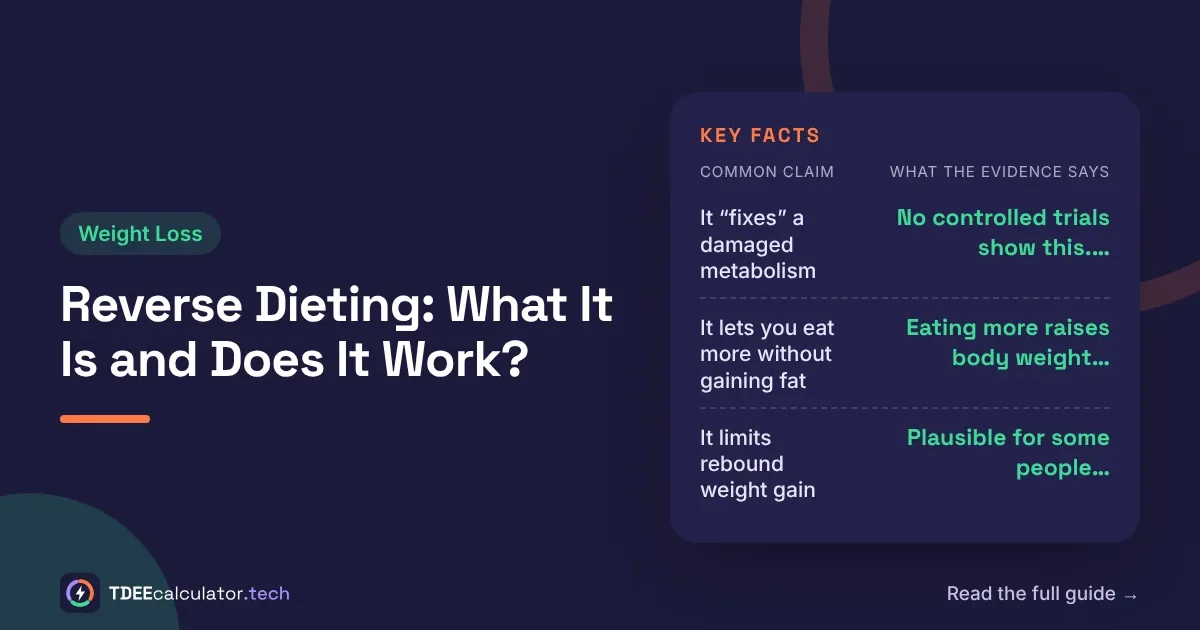
| Common claim | What the evidence says |
|---|---|
| It “fixes” a damaged metabolism | No controlled trials show this. TDEE after a diet mostly reflects your new body size. |
| It lets you eat more without gaining fat | Eating more raises body weight somewhat (food, water, glycogen). Whether that is fat depends on whether you exceed your TDEE. |
| It limits rebound weight gain | Plausible for some people, because it adds structure. Not well tested. |
Reviews of metabolic adaptation in athletes (for example Trexler, Smith-Ryan and Norton, 2014) discuss gradual increases after a diet as a practical option, while noting the lack of direct evidence.
Reverse diet vs going straight to maintenance
Straight to maintenance: you calculate your new maintenance and eat it from the next day. Faster, simpler. Expect 1–2 kg of water and glycogen return in the first week or two.
Reverse diet: you approach maintenance over several weeks. Slower, more gradual change on the scale, but you spend extra weeks below maintenance, which can prolong hunger and tiredness.
Either is reasonable. Choose the one you can follow.
A simple step-up plan
- Estimate your new maintenance with the TDEE calculator at your current weight.
- Start at your diet calories plus about 150 kcal.
- Each week, add another 100–150 kcal, mostly from carbohydrates and fats.
- Track weekly average weight. If it rises more than about 0.25 kg a week after the first water gain, hold the increase for a week.
- Stop increasing when you reach your estimated maintenance, then confirm it with a 4-week weight log.
Example: diet intake 1,700 kcal; estimated maintenance 2,250 kcal. Weeks 1–4: 1,850 → 1,975 → 2,100 → 2,225 kcal, then hold.
When a reverse diet does not make sense
- You were never in a deficit (you cannot reverse what you did not cut).
- You are trying to gain muscle; a planned surplus is more direct (see the lean bulk guide on this site).
- You feel unwell or are under-eating for health reasons: speak to a doctor or dietitian and return to normal eating with professional support.
To understand what part of TDEE you are rebuilding, Tuff Search explains TDEE vs BMR.
Sources
- Trexler ET, Smith-Ryan AE, Norton LE (2014). Metabolic adaptation to weight loss: implications for the athlete. J Int Soc Sports Nutr 11:7. https://jissn.biomedcentral.com/articles/10.1186/1550-2783-11-7
This article is general information for healthy adults, not medical advice.