Metabolic adaptation (also called adaptive thermogenesis) means your body burns somewhat fewer calories than its new, smaller size would predict while you are dieting. It is real, but in most people it is modest. Most stalls are caused by water retention, logging gaps or less daily movement, so check those first.
What happens to energy use during a diet
When you eat less for weeks, several things change:
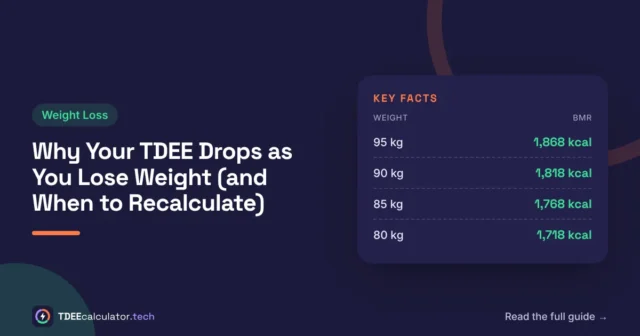
- Body size falls, so BMR and the cost of movement fall. This is expected, not adaptation. See why TDEE drops as you lose weight.
- Spontaneous movement often drops. People fidget, stand and walk less without noticing.
- Muscles may work slightly more efficiently, and hormones linked to energy balance, such as leptin and thyroid hormone, can fall.
The part of the drop that body size does not explain is what researchers call adaptive thermogenesis.
How big is it?
It varies widely. Studies by Rosenbaum and Leibel found energy expenditure after weight loss was lower than predicted from body composition, partly through changes in muscle efficiency. In a long-term follow-up of contestants from a televised weight-loss competition (Fothergill et al., 2016), resting metabolic rate six years later was on average about 500 kcal a day below what their size predicted. That was an extreme case: very fast, very large weight loss with heavy exercise.
For ordinary, moderate diets, the extra drop is usually much smaller. It can still be enough to slow progress.
Real stall or water?
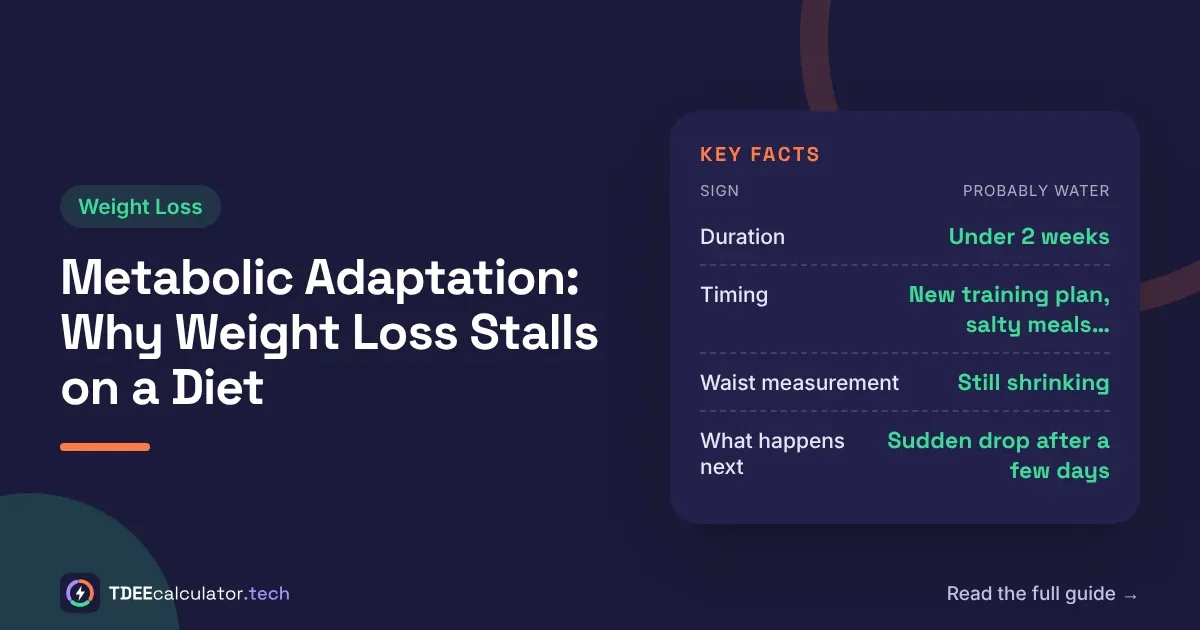
| Sign | Probably water | Probably a real plateau |
|---|---|---|
| Duration | Under 2 weeks | 3–4 weeks or more |
| Timing | New training plan, salty meals, period, poor sleep, stress | No obvious trigger |
| Waist measurement | Still shrinking | Not changing |
| What happens next | Sudden drop (“whoosh”) after a few days | No change |
Use weekly average weight and a waist measurement, not single weigh-ins.
Checklist before cutting calories further
- Logging. Weigh food for one week. Unlogged oils, drinks and bites are the most common cause of a stall.
- Steps. Compare your average daily steps now with when you started. A drop of 3,000 steps a day can remove roughly 85–100 kcal for a 70–80 kg person.
- Activity level. Is the level you chose still accurate? Tuff Search explains TDEE activity multipliers.
- Recalculate. Enter your current weight on the TDEE calculator.
- Then adjust intake by 100–150 kcal, or add movement.
Ways to limit adaptation
- Use a moderate deficit rather than a crash diet.
- Keep protein high and keep resistance training to protect muscle.
- Keep a daily step target.
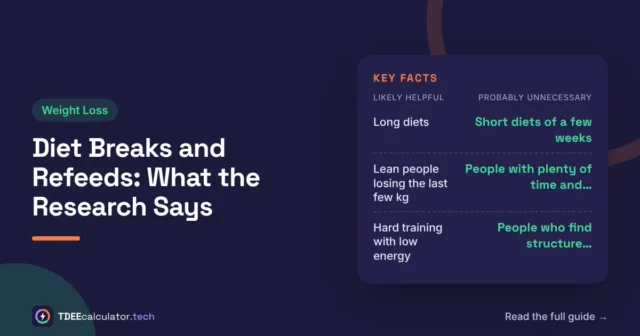
- Consider planned maintenance periods; the evidence is reviewed in diet breaks and refeeds.
- Sleep enough; short sleep tends to raise appetite.
FAQ
Is “starvation mode” real? Your body does not stop losing fat while you are in a true energy deficit. Adaptation slows the rate; it does not make fat loss impossible.
Does adaptation go away? Some of it reverses when you return to maintenance and regain some energy stores, but research suggests part can persist after large weight loss.
Sources
- Rosenbaum M, Leibel RL (2010). Adaptive thermogenesis in humans. Int J Obes 34(Suppl 1):S47–S55. https://pubmed.ncbi.nlm.nih.gov/20935667/
- Fothergill E, et al. (2016). Persistent metabolic adaptation 6 years after “The Biggest Loser” competition. Obesity 24(8):1612–1619. https://pubmed.ncbi.nlm.nih.gov/27136388/
This article is general information for healthy adults, not medical advice.