Your TDEE falls as you lose weight because a smaller body needs less energy to run and to move. For a typical man, each 5 kg lost lowers estimated TDEE by roughly 75–85 kcal a day. Over a large weight loss, that turns a 500 kcal deficit into a much smaller one unless you update your target.
Three reasons TDEE goes down
- Lower BMR. Less body tissue to maintain means fewer calories at rest. In Mifflin-St Jeor, each 1 kg less weight lowers BMR by 10 kcal.
- Cheaper movement. Walking, climbing stairs and exercise cost less energy when you carry less weight.
- Metabolic adaptation. During a diet, energy use can fall a little more than body size alone predicts. See metabolic adaptation.
How much it changes: an example
Man, 40 years, 178 cm, moderately active (× 1.55), Mifflin-St Jeor:
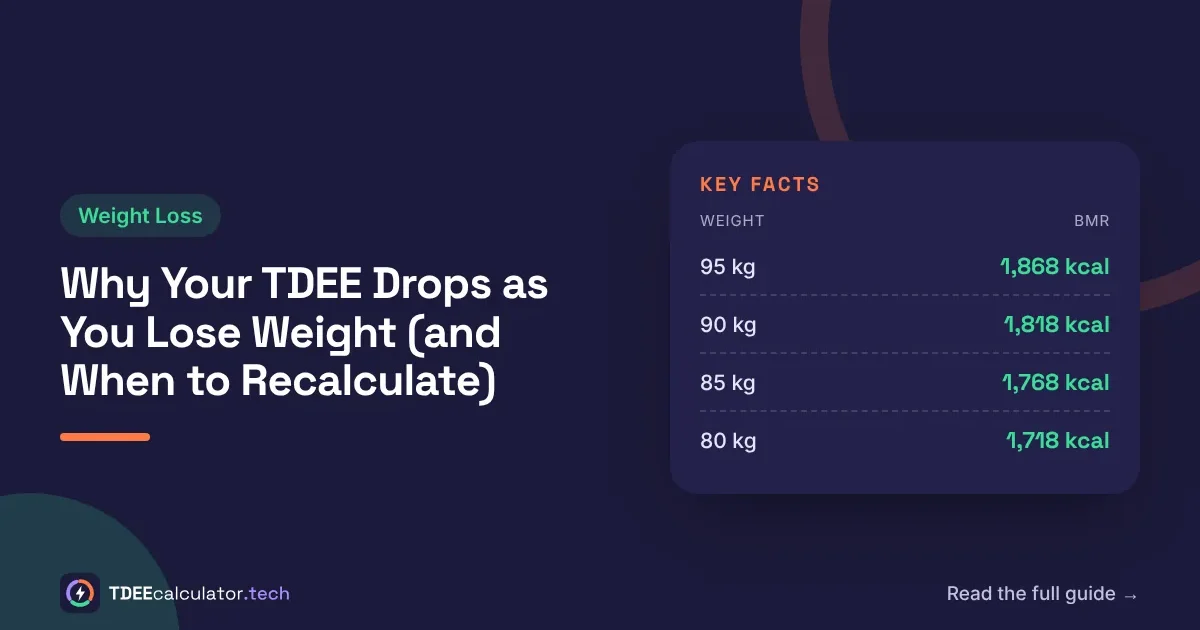
| Weight | BMR | Estimated TDEE | Change from start |
|---|---|---|---|
| 95 kg | 1,868 kcal | 2,895 kcal | — |
| 90 kg | 1,818 kcal | 2,817 kcal | −78 kcal |
| 85 kg | 1,768 kcal | 2,740 kcal | −155 kcal |
| 80 kg | 1,718 kcal | 2,662 kcal | −233 kcal |
If he started at 2,395 kcal (a 500 kcal deficit at 95 kg) and never changed it, his deficit at 80 kg would be only about 267 kcal (2,662 − 2,395). His weight loss would slow to about half the original pace. Real life may show a bigger slowdown because the formula does not capture adaptation or changes in daily movement.
Why the simple calorie rule overpredicts
The old rule says 500 kcal a day less equals about 0.5 kg (1 lb) lost each week, forever. It ignores the falling TDEE shown above. Mathematical models by Kevin Hall and colleagues at the US National Institutes of Health account for this and predict a curve that flattens over months. We explain more in the 3,500-calorie rule.
When to recalculate
- After every 4–5 kg (about 10 lb) of weight change.
- When your weekly average weight has not moved for 3–4 weeks while your logging is accurate.
- When your activity changes, such as a new job or training plan.
Use the TDEE calculator with your current weight, then confirm with your weight trend.
What you can do about it
- Accept a slower pace. Some slowing is normal and expected.
- Keep daily movement up. Steps and general activity tend to drop during a diet without you noticing. A step target helps.
- Keep protein high and keep lifting weights. This helps you keep muscle, which supports energy use.
- Lower intake in small steps. Reduce by 100–150 kcal rather than making big cuts.
- Take planned breaks. Some people find a week or two at maintenance easier to sustain; see the research on diet breaks.
Do not go below about 1,200 kcal (women) or 1,500 kcal (men) a day without medical supervision. Tuff Search’s calorie deficit guide explains how to choose a safe deficit.
FAQ
Is my metabolism “broken”? No. A lower TDEE after weight loss is mostly the expected result of being smaller.
Will my TDEE go back up if I regain weight? Yes. A larger body needs more energy.
Sources
- Hall KD, et al. (2011). Quantification of the effect of energy imbalance on bodyweight. Lancet 378:826–837. https://doi.org/10.1016/S0140-6736(11)60812-X
- NIDDK Body Weight Planner. https://www.niddk.nih.gov/bwp
This article is general information for healthy adults, not medical advice.