A diet break is a planned period, usually 1–2 weeks, of eating at maintenance calories in the middle of a diet. A refeed is shorter, usually 1–2 higher-calorie days. Research is mixed: one well-known trial found better results with diet breaks, while others found similar fat loss either way. Their main proven benefit may be making a diet easier to stick to.
The MATADOR trial
The MATADOR study (Byrne et al., 2018) gave men with obesity 16 weeks of dieting at about two-thirds of their energy needs. One group dieted continuously. The other alternated 2 weeks of dieting with 2 weeks at maintenance, so the same 16 diet weeks took 30 weeks in total.
Among men who completed the study as planned, the intermittent group lost more weight (about 14 kg vs 9 kg) and more fat (about 12 kg vs 8 kg). At a 6-month follow-up, they also kept more weight off. The authors suggested the breaks may have reduced adaptive thermogenesis (see metabolic adaptation).
Later studies
- ICECAP (Peos et al., 2021): 61 resistance-trained adults dieted for 12 weeks either continuously or in 3-week blocks separated by 1-week diet breaks. Fat loss and muscle retention were similar. A secondary analysis found that right after a diet break, people reported less hunger and irritability.
- Refeed study (Campbell et al., 2020): resistance-trained people dieted for 7 weeks with or without 2 higher-carbohydrate days per week. Fat loss was similar; the refeed group kept slightly more fat-free mass, although a later reanalysis questioned how meaningful that difference was.
Summary: diet breaks and refeeds do not appear to harm fat loss over the same number of diet weeks, may help some people, and clearly make the total plan longer.
How to plan a diet break
- Find your current maintenance calories with the TDEE calculator at your current weight, or with your own weight log.
- For 1–2 weeks, eat at that number. Raise intake mostly from carbohydrates; keep protein the same.
- Expect the scale to rise 0.5–1.5 kg from water and glycogen. This is not fat.
- Return to your diet calories. The water usually drops within a week.
How to plan refeed days
- 1–2 days a week at about maintenance, extra calories mainly from carbohydrate.
- Keep your weekly total in mind: refeeds reduce the weekly deficit unless the other days are lower. Our calorie cycling guide shows how to balance the week.
Who might benefit
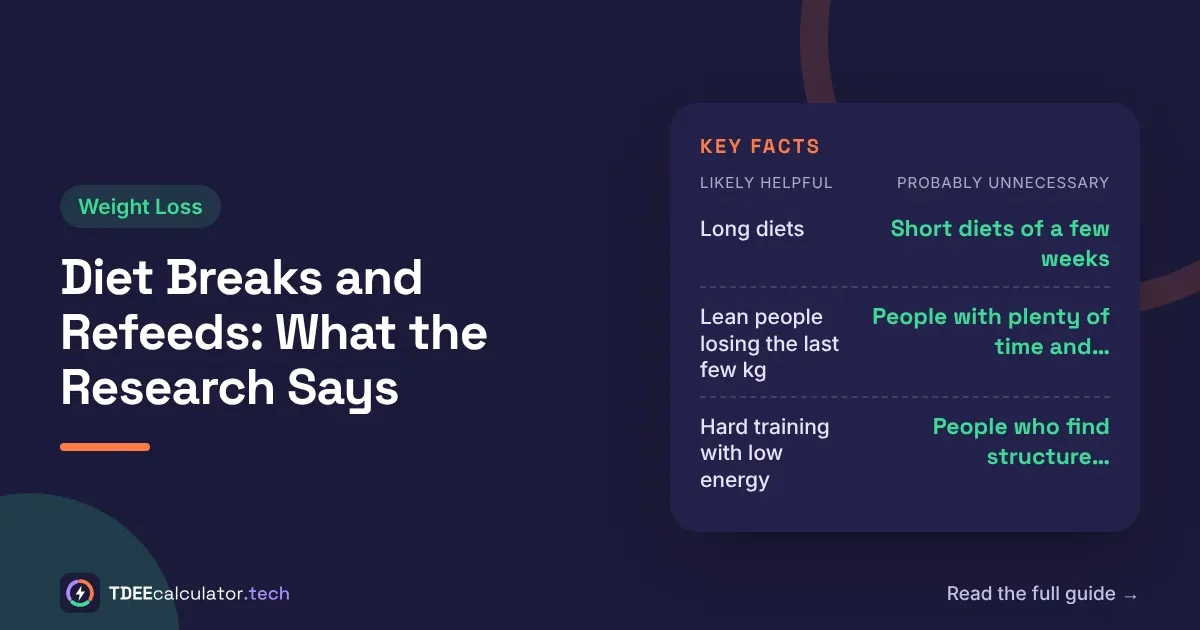
| Likely helpful | Probably unnecessary |
|---|---|
| Long diets (12+ weeks) | Short diets of a few weeks |
| Lean people losing the last few kg | People with plenty of time and no diet fatigue |
| Hard training with low energy | People who find structure changes confusing |
Choosing the right deficit in the first place matters more. Tuff Search explains how to set a calorie deficit.
Sources
- Byrne NM, et al. (2018). Intermittent energy restriction improves weight loss efficiency in obese men: the MATADOR study. Int J Obes 42:129–138. https://pubmed.ncbi.nlm.nih.gov/28925405/
- Peos JJ, et al. (2021). Continuous versus intermittent dieting for fat loss and fat-free mass retention in resistance-trained adults: the ICECAP trial. Med Sci Sports Exerc 53(8):1685–1698. https://pubmed.ncbi.nlm.nih.gov/33587549/
- Peos JJ, et al. (2021). A 1-week diet break improves muscle endurance during an intermittent dieting regime in adult athletes. PLoS One 16(2):e0247292. https://doi.org/10.1371/journal.pone.0247292
- Campbell BI, et al. (2020). Intermittent energy restriction attenuates the loss of fat free mass in resistance trained individuals. J Funct Morphol Kinesiol 5(1):19.
This article is general information for healthy adults, not medical advice.