A typical hour of weight training burns fewer calories than an hour of running, because much of the session is rest between sets. Its bigger effect is on what your body does with the calories: with enough protein, it helps you keep or build muscle. Most lifters with desk jobs who train 3–5 times a week fit “lightly active” or “moderately active”.
How many calories does lifting burn?
The Compendium of Physical Activities lists resistance training at roughly 3.5 METs for light effort and about 6 METs for vigorous effort. For an 80 kg lifter, a 60-minute session at 5 METs is about 5 × 80 × 1 = 400 kcal gross, including roughly 80 kcal they would burn at rest anyway. Short rests, supersets and big compound lifts push the number higher; long rests and machine work push it lower.
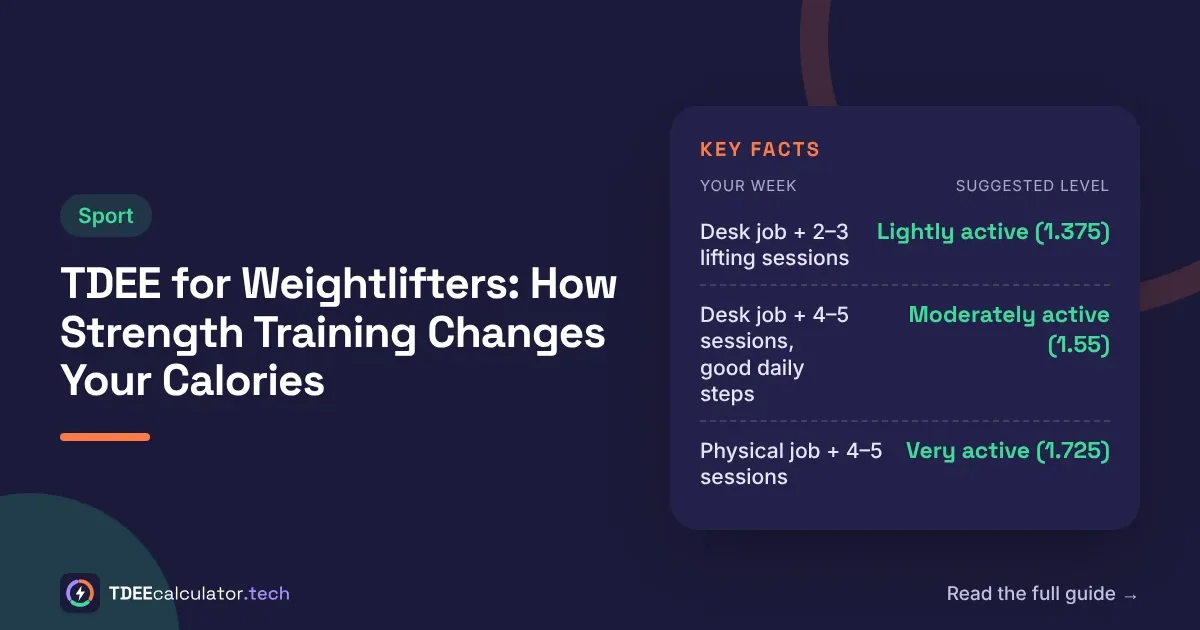
Choosing your activity level
| Your week | Suggested level |
|---|---|
| Desk job + 2–3 lifting sessions | Lightly active (1.375) |
| Desk job + 4–5 sessions, good daily steps | Moderately active (1.55) |
| Physical job + 4–5 sessions | Very active (1.725) |
Enter your details on the TDEE calculator. If you know your body fat percentage, compare with the Katch-McArdle result, which can suit muscular people better.
Protein for lifters
A 2018 meta-analysis by Morton and colleagues found that gains in muscle mass from resistance training levelled off at about 1.6 g of protein per kg of body weight per day, with an upper confidence limit of about 2.2 g/kg. Practical range: 1.6–2.2 g/kg/day, spread over 3–5 meals.
| Body weight | 1.6 g/kg | 2.2 g/kg |
|---|---|---|
| 60 kg | 96 g | 132 g |
| 75 kg | 120 g | 165 g |
| 90 kg | 144 g | 198 g |
Calories by goal
| Goal | Daily calories | See |
|---|---|---|
| Build muscle, minimal fat gain | TDEE + 250–300 kcal | Lean bulk calories |
| Lose fat, keep muscle | TDEE − 300–500 kcal | Keep lifting and protein high |
| Beginner or returning lifter | Around TDEE | Body recomposition |
Track strength as well as weight
On a lifting program, scale weight alone can mislead. Track key lifts too. Tuff Search’s guide shows how to calculate your one-rep max from a set of reps, so you can see progress without maxing out.
If you also run or do a lot of cardio, see TDEE for runners for how to account for it.
Sources
- Morton RW, et al. (2018). A systematic review, meta-analysis and meta-regression of the effect of protein supplementation on resistance training-induced gains in muscle mass and strength. Br J Sports Med 52:376–384. https://doi.org/10.1136/bjsports-2017-097608
- Ainsworth BE, et al. (2011). 2011 Compendium of Physical Activities. https://pacompendium.com/
This article is general information for healthy adults, not medical advice.