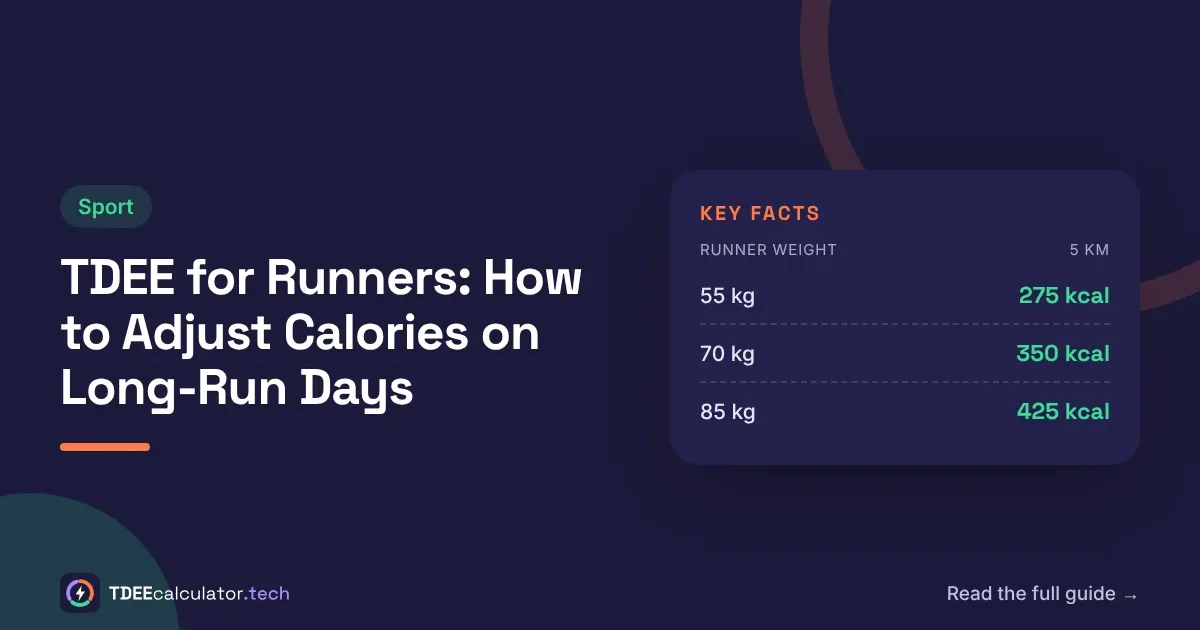
A simple rule of thumb for running is about 1 kcal per kg of body weight per km, whatever your pace. A 70 kg runner covering 40 km a week uses roughly 2,800 kcal on running alone. Set your activity level for an average week, then add carbohydrate on long-run days.
The 1 kcal per kg per km rule
Classic studies of running energy cost (Margaria and colleagues, 1963) found the cost per kilometre is fairly constant across normal running speeds. Faster running burns more per minute but about the same per kilometre.
| Runner weight | 5 km | 10 km | 21.1 km | Weekly 40 km |
|---|---|---|---|---|
| 55 kg | 275 kcal | 550 kcal | 1,161 kcal | 2,200 kcal |
| 70 kg | 350 kcal | 700 kcal | 1,477 kcal | 2,800 kcal |
| 85 kg | 425 kcal | 850 kcal | 1,794 kcal | 3,400 kcal |
These are gross figures and include the energy you would burn at rest during that time. Hills, wind, trail surfaces and running form change the real number.
Two ways to set TDEE as a runner
Method A: activity level. Choose a level that matches your weekly training on the TDEE calculator:
| Weekly running | Typical level (if job is mostly sitting) |
|---|---|
| 10–20 km, 2–3 runs | Lightly active (1.375) |
| 25–45 km, 4–5 runs | Moderately active (1.55) |
| 50–80 km, 6+ runs | Very active (1.725) |
| 80+ km or two-a-days | Extra active (1.9) — check against your weight |
Method B: sedentary base plus running. Sedentary TDEE + (weekly km × weight × 1 kcal) ÷ 7. Use one method, not both; see should you eat back exercise calories?
Example
Runner, 30 years, female, 165 cm, 58 kg, 35 km a week.
- BMR (Mifflin) = 580 + 1,031.25 − 150 − 161 = 1,300 kcal
- Method A, moderately active: 1,300 × 1.55 = 2,015 kcal
- Method B: sedentary 1,560 + (35 × 58 ÷ 7 = 290) = 1,850 kcal
The two methods differ by about 165 kcal. Use either as a start and adjust using a 4-week weight trend.
Long-run days
On a long-run day, eat more, mostly carbohydrate, before and after the run. You can keep the weekly total the same by eating a little less on rest days; see calorie cycling. For runs longer than about 60–90 minutes, sports nutrition guidance generally recommends taking in carbohydrate during the run.
Signs you are under-eating
- Persistent tiredness, poor sleep, falling performance.
- Frequent illness or injuries.
- For women, missed or irregular periods.
Low energy availability in athletes can harm bone and hormone health. If these signs appear, talk to a doctor or sports dietitian.
For walking days and cross-training, Tuff Search has a walking calorie calculator.
Sources
- Margaria R, et al. (1963). Energy cost of running. J Appl Physiol 18:367–370. https://doi.org/10.1152/jappl.1963.18.2.367
- Thomas DT, Erdman KA, Burke LM (2016). American College of Sports Medicine joint position statement: nutrition and athletic performance. Med Sci Sports Exerc 48(3):543–568.
This article is general information for healthy adults, not medical advice.