If your TDEE already uses an activity level that includes your workouts, do not eat back exercise calories. You would be counting the same exercise twice. Only eat back some of them if you set your TDEE at “sedentary” on purpose, and even then use about half of what a watch reports.
The double-counting problem
A TDEE calculator multiplies BMR by an activity factor. “Moderately active (× 1.55)” already assumes 3–5 workouts a week. If you then add the 400 kcal your watch shows for a run, you count that run twice.
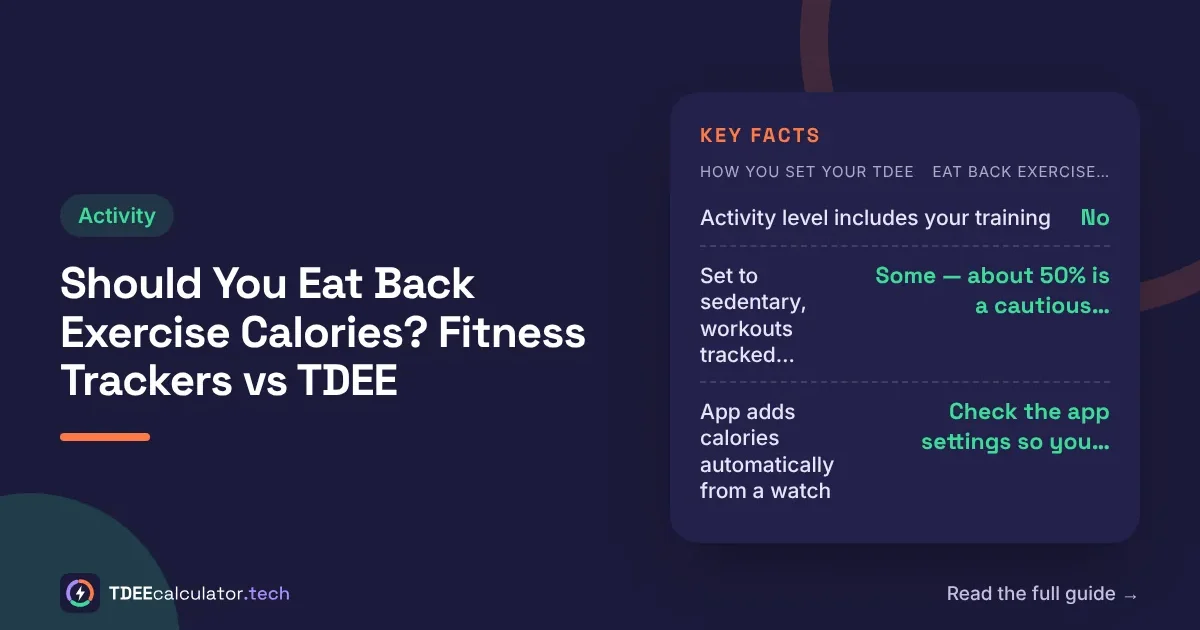
| How you set your TDEE | Eat back exercise calories? |
|---|---|
| Activity level includes your training (lightly active or higher) | No |
| Set to sedentary, workouts tracked separately | Some — about 50% is a cautious starting point |
| App adds calories automatically from a watch | Check the app settings so you are not using two methods at once |
How accurate are fitness watches for calories?
Not very. A Stanford study (Shcherbina et al., 2017) tested seven wrist devices on 60 volunteers. Heart rate was fairly accurate for most devices, but none measured energy expenditure with an error under 20%. The best device averaged about 27% error, and the worst far more.
Device makers update their algorithms, but calorie estimates from the wrist remain the least reliable number on the watch. A run shown as 500 kcal could easily be 375 or 625.
A better way: use your scale
Your weight trend is the most direct measure of whether intake matches output.
- Pick one method: activity factor or sedentary-plus-exercise.
- Eat to that target for 3–4 weeks and log accurately.
- Compare weekly average weights and adjust. Our guide to finding your real TDEE from a weight log shows the formula.
When eating back some calories makes sense
- Very long sessions, such as a 3-hour bike ride or a marathon training run, that your normal activity level does not cover.
- Irregular training, where some weeks you train 6 times and others not at all.
- Hunger and performance problems on hard days. A bit more food on those days can help; see calorie cycling.
Do not forget everyday movement
Steps, chores and standing (NEAT) often change more than gym time. If you walk much less on rest days, your real TDEE drops even if your workouts stay the same. See NEAT.
Unsure which activity level fits? Tuff Search explains TDEE activity multipliers in detail.
Set your activity level on the TDEE calculator once, and let it cover your workouts, rather than adding watch calories on top.
Sources
- Shcherbina A, et al. (2017). Accuracy in wrist-worn, sensor-based measurements of heart rate and energy expenditure in a diverse cohort. J Pers Med 7(2):3. https://doi.org/10.3390/jpm7020003
This article is general information for healthy adults, not medical advice.