Body recomposition means losing fat and gaining muscle at the same time, often while body weight stays about the same. It works best for beginners, people returning after a break, and people with higher body fat. It is slower and less reliable for experienced, lean lifters.
Does it really happen?
Yes. A 2020 review by Barakat and colleagues looked at studies of trained people and found that body recomposition was possible in this group too, especially with high protein intake and a well-designed resistance training program. The effect is usually larger in untrained people.
Who it suits best
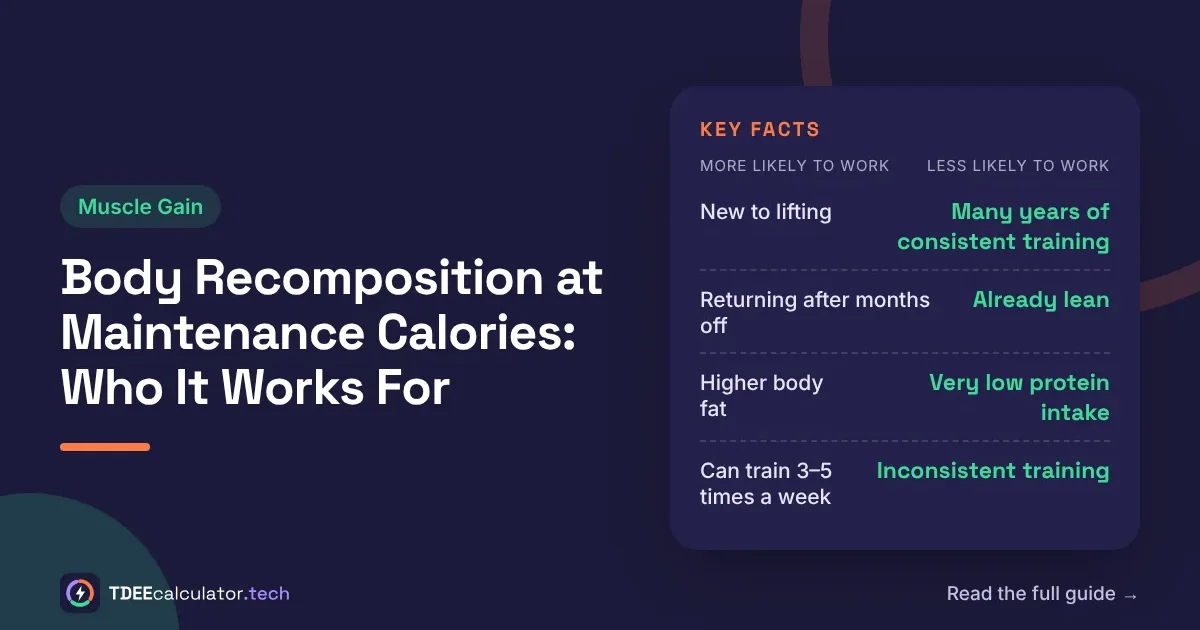
| More likely to work | Less likely to work |
|---|---|
| New to lifting | Many years of consistent training |
| Returning after months off | Already lean (for example, men under ~12% body fat) |
| Higher body fat | Very low protein intake |
| Can train 3–5 times a week | Inconsistent training |
How to set it up
- Calories: eat at your TDEE, or up to about 200 kcal below it. Find TDEE with the TDEE calculator.
- Protein: 1.6–2.2 g per kg of body weight per day. Tuff Search shows how to work out your protein needs.
- Training: a structured resistance program 3–5 times a week, adding weight or reps over time.
- Sleep: 7–9 hours supports recovery.
How to track progress
The scale may barely move, so track:
- Waist measurement every 2 weeks.
- Main lifts in a log.
- Body fat by the same method each time; see measuring body fat at home.
- Photos in the same light every 4 weeks.
Good sign: weight steady, waist down, lifts up.
Realistic expectations
Recomposition is slower than a dedicated cut or bulk. After a few months, if progress stalls, choose a clear phase. Our guide to cut, bulk or recomp helps you decide.
Sources
- Barakat C, et al. (2020). Body recomposition: can trained individuals build muscle and lose fat at the same time? Strength Cond J 42(5):7–21. https://doi.org/10.1519/SSC.0000000000000584
- Morton RW, et al. (2018). Br J Sports Med 52:376–384. https://doi.org/10.1136/bjsports-2017-097608
This article is general information for healthy adults, not medical advice.