
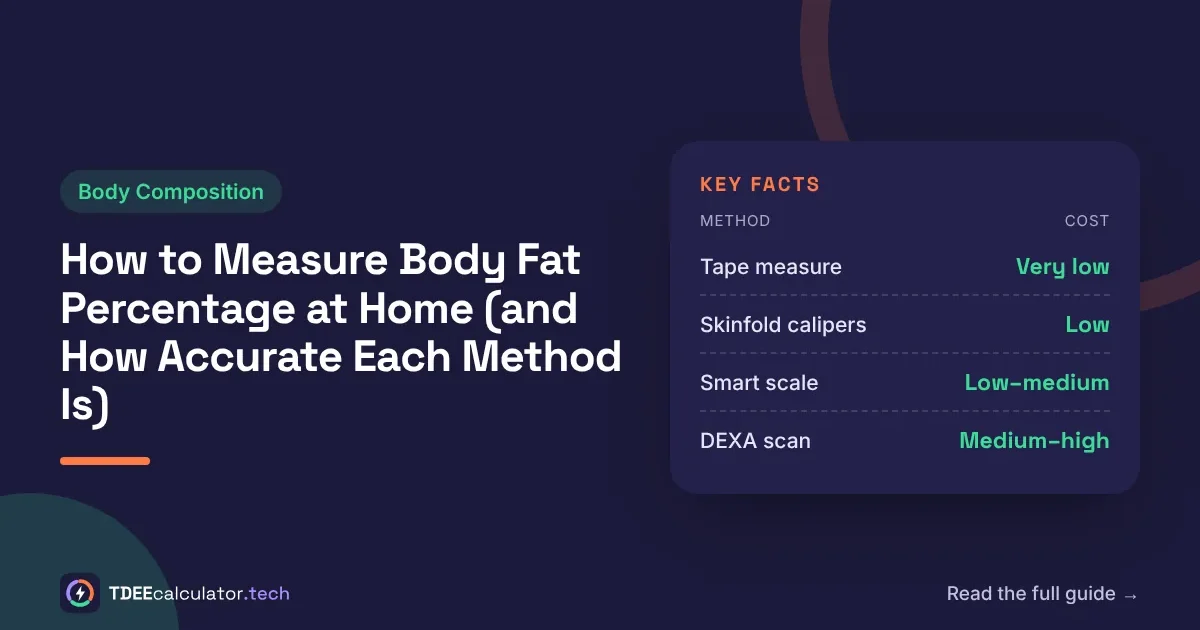
The easiest home method is a tape measure and the US Navy formula. Skinfold calipers can be more accurate if the same trained person measures you each time. Smart scales are convenient but can be off by several percentage points. DEXA, done at a clinic, is the usual reference method.
Methods compared
| Method | Cost | Where | Typical accuracy | Best use |
|---|---|---|---|---|
| Tape measure (US Navy formula) | Very low | Home | Moderate; a few % error is common | Tracking change over time |
| Skinfold calipers | Low | Home or gym | Good with a skilled tester; poor when self-measured | Lean people, regular checks |
| Smart scale (bioelectrical impedance) | Low–medium | Home | Varies a lot with hydration | Trends only, same time of day |
| DEXA scan | Medium–high | Clinic | Reference method in most studies | A baseline or a check once or twice a year |
No method is exact. Pick one, use it the same way every time, and look at the trend.
The US Navy tape method (step by step)
You need a flexible tape measure. Measure in inches for the formula below (1 inch = 2.54 cm).
- Height: standing straight, without shoes.
- Neck: just below the larynx (Adam’s apple), tape sloping slightly down to the front.
- Waist: men at the navel; women at the narrowest point of the waist.
- Hips (women only): at the widest point of the buttocks.
- Take each measurement twice and use the average.
Men:
Body fat % = 86.010 × log10(waist − neck) − 70.041 × log10(height) + 36.76Women:
Body fat % = 163.205 × log10(waist + hip − neck) − 97.684 × log10(height) − 78.387Example (man): height 70 in, neck 15 in, waist 34 in. waist − neck = 19 → log10(19) = 1.2788; log10(70) = 1.8451. 86.010 × 1.2788 = 109.99; 70.041 × 1.8451 = 129.23. Body fat = 109.99 − 129.23 + 36.76 = about 17.5%.
Tips for skinfold calipers
- Use the same sites and the same tester each time.
- Measure on the right side of the body, skin relaxed.
- Take each site twice; if readings differ by more than 1–2 mm, take a third.
- Self-measuring the back and triceps is hard, so results vary more.
Getting usable smart-scale readings
Smart scales pass a small current through the body and estimate fat from resistance. Water changes the reading, so:
- Weigh at the same time each morning, after the toilet and before drinking.
- Avoid readings after exercise, a sauna or alcohol.
- Use weekly averages.
Which number should you use for TDEE?
If you have a DEXA result or consistent caliper readings, enter it on the TDEE calculator to unlock the Katch-McArdle formula. If your only number is from a smart scale, use Mifflin-St Jeor as your main result and Katch-McArdle as a rough comparison.
Body fat also tells you more than BMI. Tuff Search covers other measures in alternatives to BMI.
Would rather not do the maths by hand? Tuff Search’s body fat calculator gives a quick estimate.
FAQ
How often should I measure body fat? Every 4–8 weeks is enough. Body fat changes slowly.
Why does my scale say something different every day? Mostly hydration. Use a weekly average.
Is body fat % useful for tracking body recomposition? Yes. When weight stays the same, waist and body fat trends show whether you are losing fat and gaining muscle.
Sources
- Hodgdon JA, Beckett MB (1984). Prediction of percent body fat for U.S. Navy men and women from body circumferences and height. Naval Health Research Center, Reports 84-11 and 84-29.
- U.S. Department of Defense body composition guidance (DoDI 1308.03).
This article is general information, not medical advice.