For a lean bulk, eat about 250–350 kcal above your TDEE and aim to gain about 0.25–0.5% of your body weight per week. Beginners can use the top of that range; experienced lifters should use the bottom, because they build muscle more slowly.
Target rate of gain
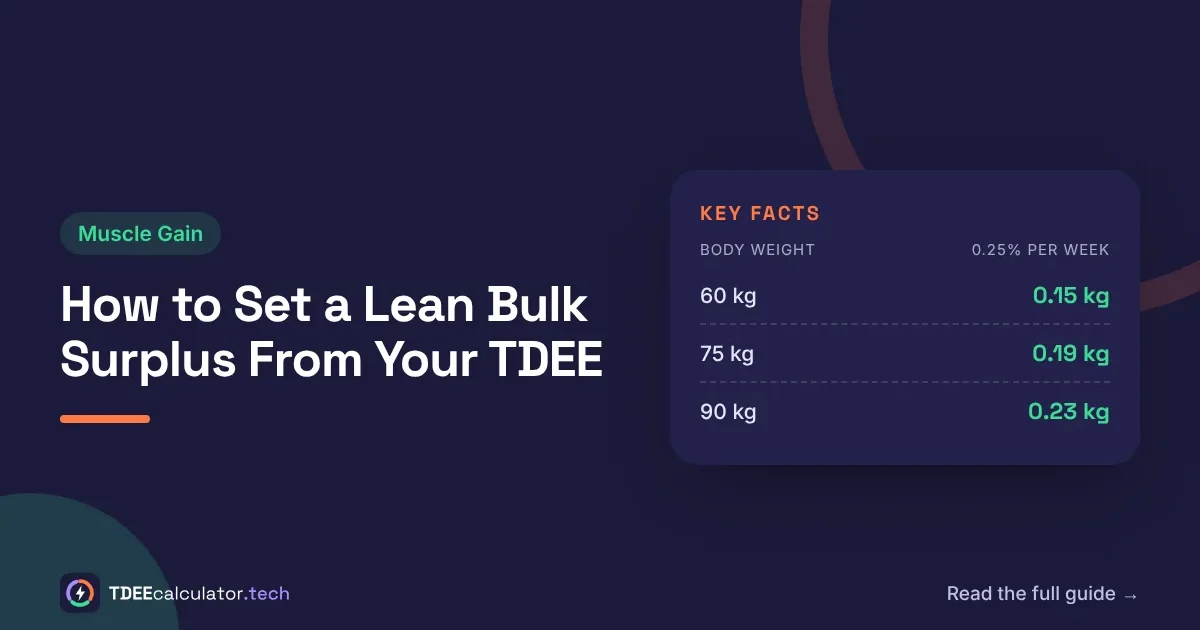
A 2019 review of off-season nutrition for bodybuilders (Iraki et al.) suggested a rate of gain of about 0.25–0.5% of body weight per week, with less experienced lifters toward the higher end.
| Body weight | 0.25% per week | 0.5% per week | Per month (approx.) |
|---|---|---|---|
| 60 kg | 0.15 kg | 0.30 kg | 0.6–1.2 kg |
| 75 kg | 0.19 kg | 0.38 kg | 0.75–1.5 kg |
| 90 kg | 0.23 kg | 0.45 kg | 0.9–1.8 kg |
From rate of gain to calories
Using the rough estimate of 7,700 kcal per kg of weight change:
- 0.2 kg a week ≈ 220 kcal a day above TDEE
- 0.3 kg a week ≈ 330 kcal a day above TDEE
Muscle tissue contains a lot of water, so its energy content differs from fat. Treat these numbers as a starting point and adjust from your weight trend.
Worked example
Man, 25 years, 180 cm, 75 kg, lifts 4 times a week, desk job.
- BMR (Mifflin) = 750 + 1,125 − 125 + 5 = 1,755 kcal
- TDEE (moderately active × 1.55) = 2,720 kcal
- Surplus +300 kcal → 3,020 kcal a day
- Protein at 1.8 g/kg = 135 g; fat at 25% of calories ≈ 84 g; carbohydrate = the rest ≈ 431 g.
Use the TDEE calculator with the “gain” goal, and see how to calculate macros from your TDEE.
Adjusting every 2–4 weeks
| Weekly average weight change | Action |
|---|---|
| Not rising after 3 weeks | Add 100–150 kcal |
| Rising within target range | Keep going |
| Rising faster than 0.5% a week (after the first 1–2 weeks of water gain) | Remove 100–150 kcal |
| Waist rising quickly while lifts stall | Reduce surplus; check training |
Track strength, not just weight
Progressive overload drives muscle growth; extra calories only support it. Log your main lifts. Tuff Search’s bench press calculator helps you estimate working weights.
Not sure whether to bulk at all? See cut, bulk or recomp?
Not sure which activity level fits your training? See TDEE for weightlifters.
Sources
- Iraki J, et al. (2019). Nutrition recommendations for bodybuilders in the off-season: a narrative review. Sports 7(7):154. https://doi.org/10.3390/sports7070154
- Morton RW, et al. (2018). Br J Sports Med 52:376–384. https://doi.org/10.1136/bjsports-2017-097608
This article is general information for healthy adults, not medical advice.