The Katch-McArdle formula estimates your basal metabolic rate (BMR) from your lean body mass instead of your total weight. It ignores age, sex and height. If your body fat percentage is measured accurately, it can suit lean and muscular people better than weight-based formulas.
The formula
Lean body mass (kg) = weight (kg) × (1 − body fat % ÷ 100)
BMR = 370 + (21.6 × lean body mass in kg)
TDEE = BMR × activity factor
Why lean mass? Muscle, organs and bone use far more energy at rest than fat tissue. Research on tissue metabolic rates gives about 13 kcal per kg per day for skeletal muscle and about 4.5 kcal per kg per day for fat tissue (Elia’s values, checked by Wang and colleagues in 2010). Two people of the same weight but different body fat can have quite different BMRs.
Worked example 1: lean man
80 kg, 15% body fat.
- Lean body mass = 80 × 0.85 = 68 kg
- BMR = 370 + (21.6 × 68) = 370 + 1,468.8 = 1,839 kcal
- Moderately active (× 1.55): TDEE = 2,850 kcal
Mifflin-St Jeor for the same man (30 years, 178 cm) gives 1,768 kcal BMR. Katch-McArdle is about 70 kcal higher because he carries more muscle than average.
Worked example 2: woman with higher body fat
75 kg, 38% body fat.
- Lean body mass = 75 × 0.62 = 46.5 kg
- BMR = 370 + (21.6 × 46.5) = 370 + 1,004.4 = 1,374 kcal
- Lightly active (× 1.375): TDEE = 1,890 kcal
The big catch: body fat errors
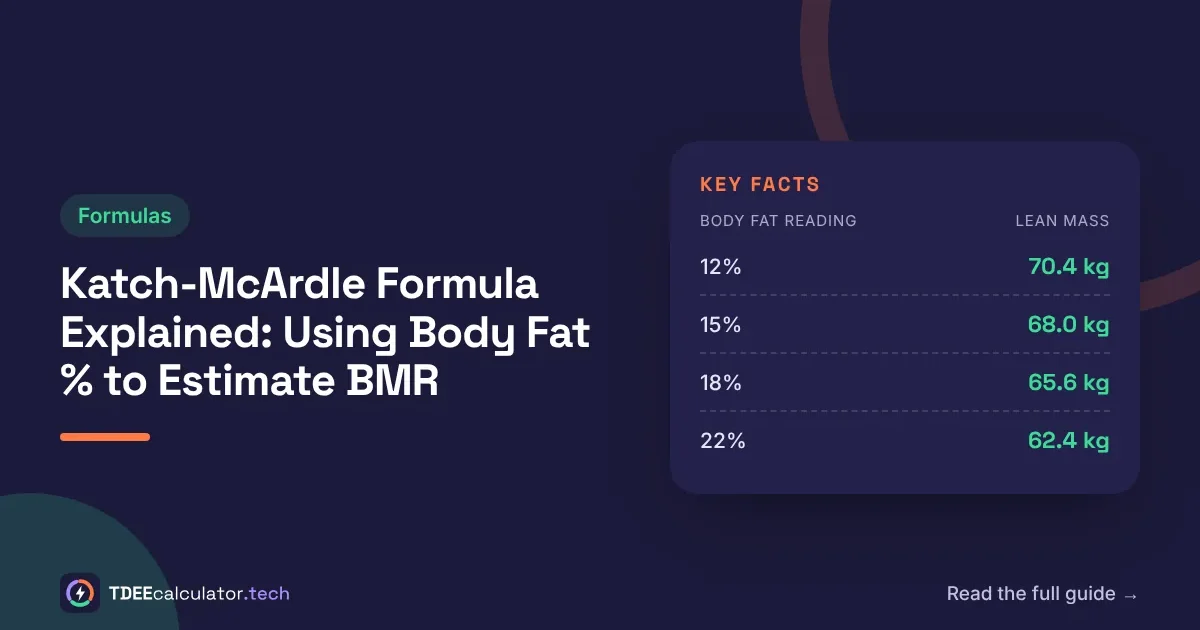
Katch-McArdle is only as good as your body fat number. Look at how a reading error changes the result for the 80 kg man:
| Body fat reading | Lean mass | BMR |
|---|---|---|
| 12% | 70.4 kg | 1,891 kcal |
| 15% | 68.0 kg | 1,839 kcal |
| 18% | 65.6 kg | 1,787 kcal |
| 22% | 62.4 kg | 1,718 kcal |
Each 1% error in body fat moves BMR by about 17 kcal for this man. Home smart scales can be off by several percent, which can shift BMR by 50–150 kcal before the activity factor makes it bigger. Our guide on measuring body fat at home compares methods.
When to use Katch-McArdle
| Use it when | Avoid relying on it when |
|---|---|
| Body fat is measured by DEXA, a skilled caliper test or a validated method | Your only number comes from a cheap scale |
| You are lean and muscular and Mifflin seems low | You have no body fat estimate at all |
| You want a second opinion on your BMR | You are under 18, pregnant or have a medical condition |
Katch-McArdle vs Cunningham
You may also see the Cunningham equation (BMR = 500 + 22 × lean body mass). It is used mainly for athletes and gives higher results than Katch-McArdle at the same lean mass. We use Katch-McArdle on the TDEE calculator because it is the more common of the two.
For the difference between resting and total energy use, see Tuff Search’s guide to TDEE vs BMR.
FAQ
Does Katch-McArdle work for women? Yes. It has no sex term, because lean mass already captures most of the difference.
Is it better than Mifflin-St Jeor? Only when your body fat is measured well. Otherwise Mifflin-St Jeor is the safer default; see which TDEE formula is most accurate.
Sources
- Wang Z, et al. (2010). Specific metabolic rates of major organs and tissues across adulthood. Am J Clin Nutr 92(6):1369–1377. https://pubmed.ncbi.nlm.nih.gov/20962155/
- McArdle WD, Katch FI, Katch VL. Exercise Physiology: Nutrition, Energy, and Human Performance (textbook source of the equation).
This article is general information for healthy adults, not medical advice.